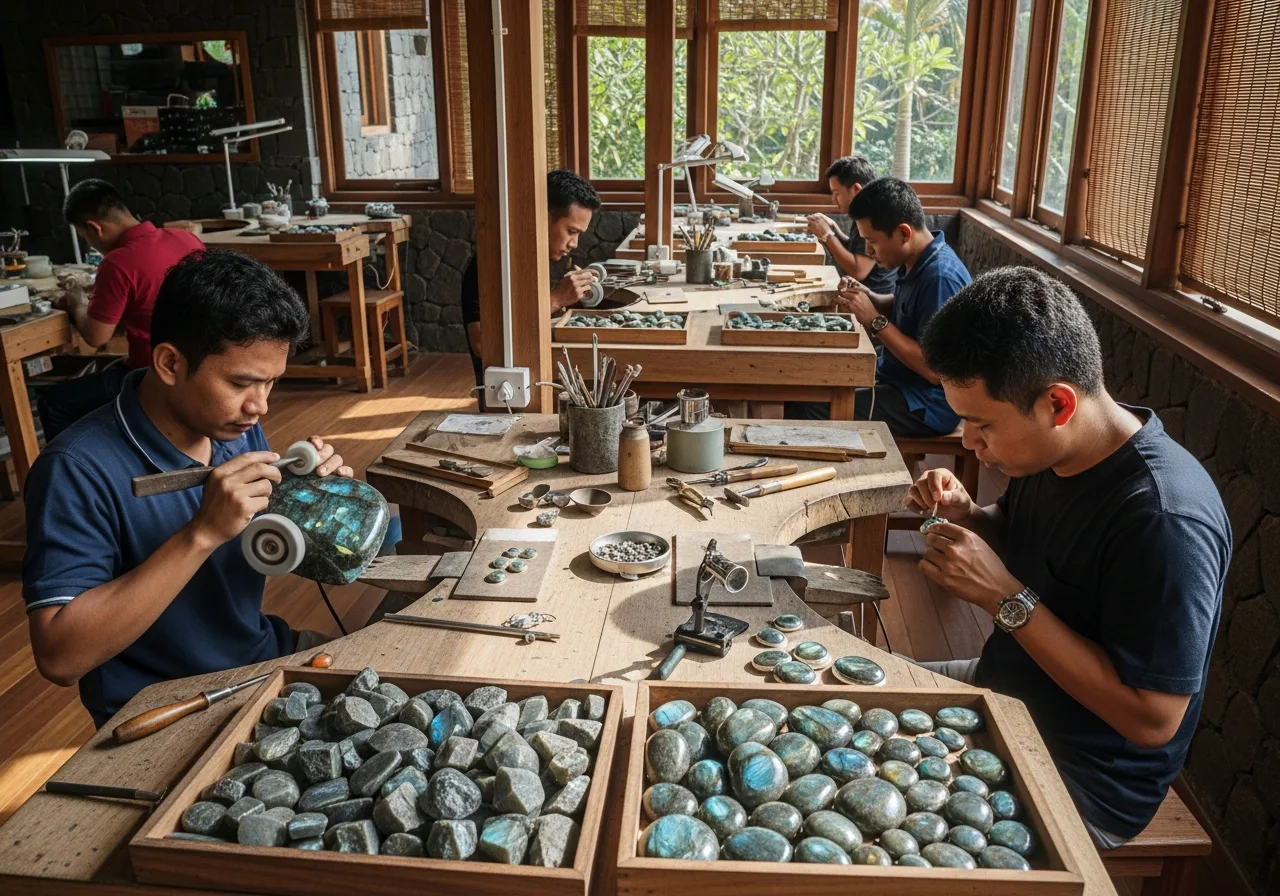
Bali labradorite, primarily a manufacturing and design hub, represents a small but growing niche within the global labradorite market. While Canada, Madagascar, and Finland are major ore sources, Bali specialises in silver and gemstone jewelry for export, contributing to an estimated USD 20–40 million in wholesale activity for labradorite jewelry and loose stones in 2026.
Bali Labradorite vs. Madagascar Labradorite: A 2027 Quality and Price Comparison
This briefing details the wholesale market for labradorite gemstones and jewelry sourced and/or manufactured in Indonesia/Bali for export and domestic wholesale, offering a comparison with Madagascar labradorite for trade buyers in 2027.
1. Market Size & Growth: Global to Indonesia/Bali
The global labradorite market is estimated between USD 0.7–1.8 billion mid-2020s. Projections indicate growth to USD 1.3–2.9 billion by 2033–2034, with a Compound Annual Growth Rate (CAGR) of approximately 5.8–9.2%.
- One study estimates the market at USD 945.75 million in 2025, reaching USD 1,562.40 million by 2033 (CAGR ≈ 6.1%).
- Another study projects USD 1.8 billion in 2025, growing to USD 2.9 billion by 2034 (CAGR ≈ 5.8%).
- A third indicates USD 0.71 billion in 2026, expanding to USD 1.3–2.0 billion by 2033 (CAGR ≈ 6.2–9.2%).
Jewelry accounts for the largest share of labradorite demand, approximately 50–52%.
The global gemstone market as a whole is valued at around USD 36–37 billion in 2025–2026, with expectations to reach USD 58.04 billion by 2033 (CAGR ≈ 6.7%). Asia-Pacific is a significant driver, contributing approximately 42% of global gemstone demand.
Indonesia/Bali Labradorite Market Share (Inferred)
Industry reports do not specifically detail Indonesia/Bali’s share of the global labradorite market, focusing instead on Canada, Madagascar, and Finland as primary supply regions. Indonesia functions predominantly as a manufacturing and jewelry-design centre rather than a primary ore source. Therefore, its market share is inferred from jewelry exports and regional demand.
Considering Asia-Pacific’s substantial role in gemstone demand (≈42%), Indonesia’s position as a regional jewelry exporter, and Bali’s specialisation in silver and gemstone jewelry for export (e.g., Bali Silver Export offers over 80 labradorite designs), the estimated wholesale activity for Indonesia/Bali’s labradorite jewelry and loose stones in 2026 is on the order of USD 20–40 million. This represents approximately 1–3% of the global labradorite market or 5–10% of Asia-Pacific’s demand for labradorite jewelry and loose stones. This indicates a small but fast-growing niche, driven by jewelry manufacturing, silver-craft exports, and metaphysical/wellness demand.
2. Quality Comparison: Bali vs. Madagascar Labradorite
Madagascar Labradorite
Madagascar is a primary source of labradorite, known for its consistent supply and varied quality. Madagascar labradorite often exhibits strong labradorescence, with a broad spectrum of colours including blues, greens, yellows, and occasionally reds or purples. The material ranges from opaque to semi-translucent. Clarity can vary significantly, with some pieces showing internal fractures or inclusions. Cut and polish quality from Madagascar can be inconsistent, particularly for lower-priced bulk material, though higher-grade polished stones are available.
Bali Labradorite (Manufactured/Processed)
Labradorite processed in Bali typically originates from various sources, including Madagascar. The distinction lies in the manufacturing and finishing. Bali’s lapidary expertise focuses on optimising the stone’s appearance through precise cutting and high-quality polishing. This often results in superior labradorescence display and smoother finishes compared to raw or less-processed material from source countries. Bali’s craftsmen are adept at selecting material that presents well and crafting it into designs suitable for the export jewelry and handicraft markets. The focus is on aesthetic appeal and market readiness.
3. Price Comparison: Wholesale (2026–2027 Estimates)
Wholesale pricing for labradorite is highly dependent on quality, size, cut, and finish. The figures below are approximate and subject to market fluctuations, supplier relationships, and order volume.
Madagascar Labradorite (Rough & Bulk Polished)
Madagascar labradorite, particularly rough or minimally processed material, tends to be more competitively priced at the source due to lower labour and processing costs. For bulk purchases of polished cabochons or tumbled stones, prices can be lower per unit compared to Bali-finished products.
- Rough Material: USD 5–20 per kilogram, depending on colour flash and clarity.
- Standard Cabochons (small to medium, bulk): USD 0.50–3.00 per carat.
- Large Cabochons/Freeforms (bulk): USD 2.00–8.00 per carat, for pieces with good flash.
- Tumbled Stones (bulk): USD 10–50 per kilogram.
Bali Labradorite (Finished Goods & Jewelry)
Bali labradorite, referring to finished goods and jewelry manufactured in Bali, commands higher prices due to the added value of skilled labour, design, and superior finishing. The price reflects the craftsmanship, quality control, and often the integration into silver or other materials.
- Finished Cabochons (medium to large, high quality): USD 2.00–15.00 per carat, depending on iridescence, clarity, and cut precision.
- Carvings/Sculptures: USD 10–100+ per piece, highly variable based on size, intricacy, and material quality.
- Silver Jewelry with Labradorite (wholesale): USD 10–100+ per piece, influenced by silver weight, design complexity, and gemstone quality.
- Loose Calibrated Stones (high-quality, for jewelry): USD 1.50–10.00 per carat.
2027 Note: Anticipate a continued upward trend in prices for high-quality labradorite with strong labradorescence due to sustained demand from the jewelry and metaphysical sectors. Supply chain stability, particularly concerning shipping costs from Madagascar to processing hubs, will remain a factor influencing final wholesale prices in Bali.
4. Sourcing Considerations for Trade Buyers
Importers and wholesalers must weigh their priorities between raw material cost and finished product quality and design. Madagascar offers direct access to raw material, suitable for buyers with their own processing capabilities or those seeking lower-cost bulk options. Bali provides value-added products, ready for retail or further distribution, with the assurance of skilled craftsmanship.
| Feature | Madagascar Labradorite (Raw/Bulk) | Bali Labradorite (Finished/Jewelry) |
|---|---|---|
| Primary Role | Ore Source, Bulk Processing | Manufacturing, Design, Finishing |
| Typical Quality | Variable, often requires further processing | High-grade finish, optimised labradorescence |
| Price Point | Lower per unit (raw/bulk) | Higher per unit (value-added, finished) |
| Key Advantage | Cost-effective raw material, quantity | Craftsmanship, design, market-ready products |
| Target Buyer | Processors, large-scale bulk importers | Jewelry wholesalers, retailers, interior contractors |
5. Market Trends Affecting Bali & Madagascar Labradorite (2027 Outlook)
Sustainability and Ethical Sourcing
Growing consumer awareness regarding ethical sourcing and sustainability will increasingly influence purchasing decisions. Buyers are seeking assurances regarding labour practices and environmental impact throughout the supply chain. This trend may lead to a premium for suppliers who can provide transparent sourcing documentation.
Demand for Unique Cuts and Designs
The market continues to favour unique cuts, custom designs, and artisan-crafted pieces. Bali’s strength lies in its ability to produce distinctive silver and gemstone jewelry, catering to this demand. This contrasts with the more standardised cuts often seen in bulk Madagascar labradorite.
E-commerce and Digital Marketing
The expansion of e-commerce platforms and digital marketing channels will continue to shape how labradorite is sold and distributed. High-quality product photography and detailed descriptions, showcasing the unique labradorescence of each stone, are crucial for online sales. Bali-based manufacturers often excel in presenting their finished products for digital marketplaces.
Metaphysical and Wellness Market
The demand for labradorite in the metaphysical and wellness sectors remains robust. This drives demand for aesthetically pleasing, well-polished stones, often in specific shapes (e.g., spheres, points, freeforms) that Bali manufacturers are adept at producing.
Understanding these distinctions is crucial for trade buyers navigating the global labradorite market in 2027. Bali Labradorite Wholesale focuses on delivering finished products that meet the quality and design standards expected by international buyers. For specific requirements and to discuss our range, we invite you to request a wholesale quote on WhatsApp.