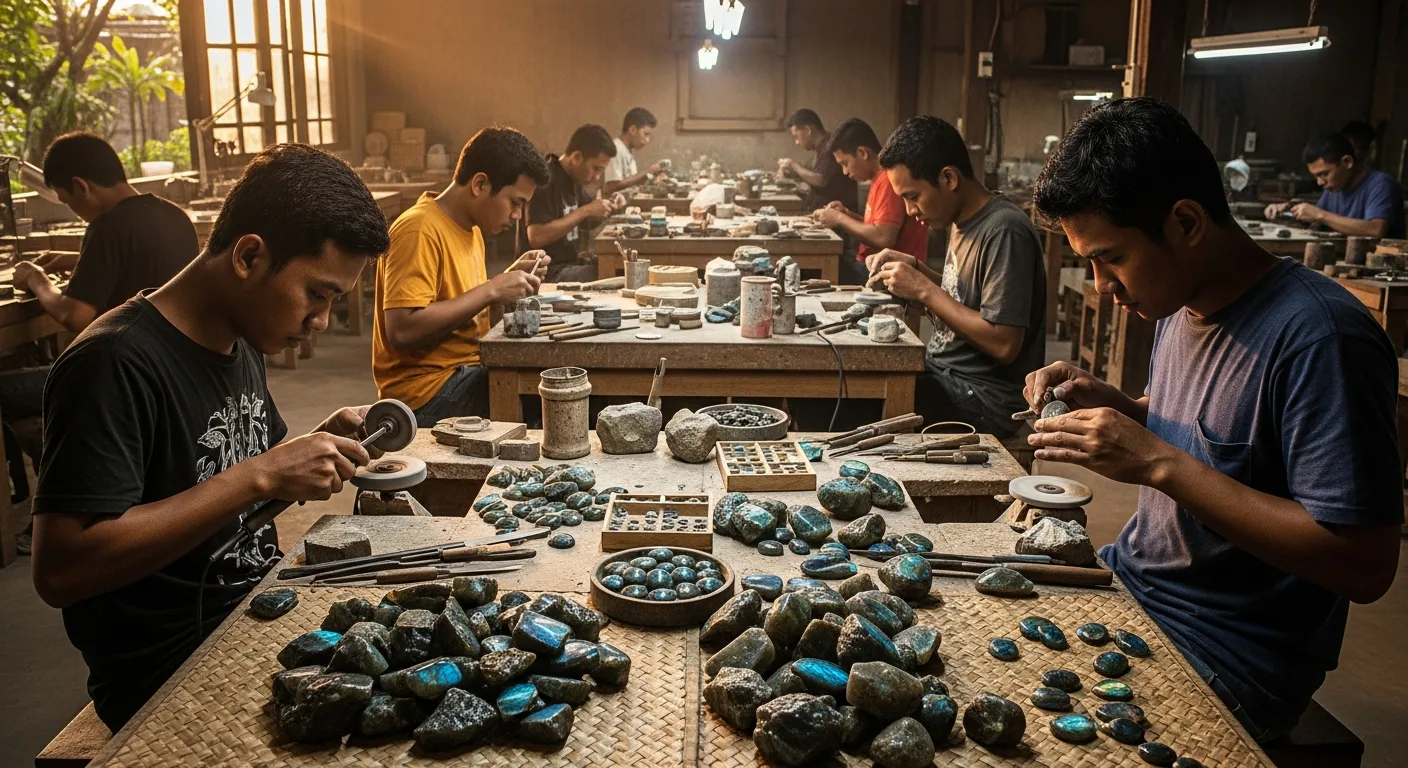
The Bali Labradorite Wholesale Buyer Guide 2027 provides essential information for importers, wholesalers, retailers, and interior contractors. It details market size, growth, and crucial methods for distinguishing authentic labradorite from imitations, ensuring informed purchasing decisions for businesses sourcing from Indonesia/Bali.
Bali Labradorite Wholesale Buyer Guide 2027: How to Spot Real vs. Fake Stones
Indonesia and Bali participate in a small but fast-growing niche within the global labradorite gemstone market. This market segment is driven primarily by jewelry manufacturing, silver-craft exports, and metaphysical/wellness demand. This briefing provides a 2026–2027 wholesale market overview for “Bali labradorite”—referring to labradorite gemstones and jewelry sourced and/or manufactured in Indonesia/Bali for export and domestic wholesale.
1. Market Size & Growth (Global → Indonesia/Bali)
Global Labradorite Benchmark
The global labradorite market size is estimated to be around USD 0.7–1.8 billion in the mid-2020s, with variations depending on the methodology used in market studies.
- One study projects the market at USD 945.75 million in 2025, expected to reach USD 1,562.40 million by 2033, indicating a Compound Annual Growth Rate (CAGR) of approximately 6.1% from 2025 to 2032.
- Another report estimates the market at USD 1.8 billion in 2025, growing to USD 2.9 billion by 2034, with a CAGR of approximately 5.8%.
- A third analysis suggests USD 0.71 billion in 2026, potentially expanding to USD 1.3–2.0 billion by 2033, showing a CAGR of approximately 6.2–9.2%.
Jewelry is the dominant end-use segment, accounting for approximately 50–52% of labradorite demand. The global gemstone market overall is valued at approximately USD 36–37 billion in 2025–2026. This market is expected to reach USD 58.04 billion by 2033, with a CAGR of approximately 6.7% from 2026 to 2033. Asia-Pacific accounts for approximately 42% of global gemstone demand.
Indonesia/Bali Labradorite Share (Inferred)
Industry reports typically do not disaggregate Indonesia/Bali specifically for labradorite, instead highlighting Canada, Madagascar, and Finland as major supply regions. Indonesia is primarily a manufacturing and jewelry-design hub, not a primary ore source. Consequently, its market share is inferred from jewelry exports and regional demand rather than direct mining output.
Based on Asia-Pacific’s leading role in gemstones (approximately 42% of global demand), Indonesia’s position as a mid-tier jewelry exporter in the region, and Bali’s specialization in silver and gemstone jewelry for export (e.g., Bali Silver Export offers over 80 labradorite designs), a reasonable order-of-magnitude for Indonesia/Bali’s labradorite-linked wholesale activity is estimated.
Indonesia’s labradorite jewelry and loose-stone wholesale market in 2026 is estimated to be on the order of USD 20–40 million, representing approximately 1–3% of the global labradorite market and 0.05–0.1% of the global gemstone market. The growth rate for this niche is projected to be approximately 8–12% annually, outpacing the global average for labradorite due to increasing regional demand and manufacturing capabilities.
2. Sourcing & Manufacturing Hub
Indonesia, particularly Bali, functions as a significant manufacturing and design hub for labradorite products. While raw labradorite ore is not primarily mined in Indonesia, the country imports rough stones for cutting, polishing, and setting into jewelry and other decorative items. This expertise in craftsmanship contributes to the value proposition of Bali labradorite products.
3. Price & Value (Wholesale)
Wholesale pricing for labradorite from Bali is influenced by several factors:
- Stone Quality: Factors include clarity, intensity of labradorescence (schiller effect), and absence of fractures.
- Carat Weight & Size: Larger, high-quality stones command higher prices.
- Cut & Polish: Precision cutting and high-quality polishing add value.
- Manufacturing Complexity: Intricate jewelry designs or custom furniture pieces will have higher labor costs.
- Quantity: Bulk orders typically receive better per-unit pricing.
- Market Demand: Fluctuations in global gemstone demand can affect prices.
As a guide, wholesale prices for well-cut, polished labradorite cabochons suitable for jewelry can range from approximately USD 2–15 per carat for standard quality, up to USD 20–50+ per carat for exceptional pieces with strong, full-spectrum labradorescence. Finished jewelry items will vary significantly based on metal content (e.g., sterling silver), design intricacy, and additional stone embellishments.
4. How to Spot Real vs. Fake Labradorite
Distinguishing genuine labradorite from imitations is crucial for wholesale buyers. Counterfeits can include glass, plastic, or other minerals dyed or treated to mimic labradorescence. Use the following methods for identification:
Visual Inspection
- Labradorescence (Schiller Effect): Genuine labradorite displays a unique play of colours—blues, greens, yellows, oranges, and sometimes purples—that appear to flash from within the stone as it is rotated. This effect is caused by light interference within lamellar twinning structures. Fakes often have a superficial sheen, or the colour play appears flat and lacks depth.
- Inclusions and Imperfections: Natural labradorite often contains minor inclusions, fractures, or dark specks. Perfectly clear or flawless stones, especially those with an unnaturally uniform colour flash, should be viewed with suspicion.
- Transparency/Translucency: Labradorite is typically translucent to opaque. If a stone is completely transparent with a strong colour flash, it is likely an imitation.
- Surface Texture: Real labradorite, when polished, has a smooth, slightly glassy feel. Fakes made of plastic might feel warmer or softer, while glass imitations may feel similar but lack the internal depth of colour.
Physical Properties
- Hardness: Labradorite has a Mohs hardness of 6 to 6.5. While not ideal for destructive testing, this means it can scratch glass (Mohs 5.5) but can be scratched by harder minerals like quartz (Mohs 7). Be cautious if a stone is easily scratched or does not scratch glass.
- Specific Gravity: Labradorite has a specific gravity of approximately 2.68–2.72. An experienced gemologist can use this to differentiate it from materials with significantly different densities.
- Temperature: Natural stones generally feel cool to the touch and take longer to warm up when held. Plastic imitations will warm up quickly.
Advanced Testing (Recommended for High-Volume Buyers)
For large wholesale purchases, consider engaging a certified gemologist. They can perform advanced tests such as:
- Refractive Index (RI): Labradorite has an RI of approximately 1.559–1.570. This is a definitive test for identifying the material.
- Spectroscopy: Can reveal the chemical composition and presence of specific elements, further confirming authenticity.
- Polariscope: Can determine if the material is isotropic or anisotropic, helping to distinguish between natural crystals and amorphous imitations like glass.
2027 Note: As manufacturing techniques for synthetic materials improve, the sophistication of labradorite imitations may increase. Buyers should remain vigilant and prioritise sourcing from established suppliers with transparent supply chains and a track record of authenticity. Verifying supplier certifications and conducting random quality checks on received shipments will be increasingly important in 2027.
5. Common Imitations and Their Characteristics
Understanding common fakes helps in identification:
| Imitation Type | Characteristics | Distinguishing Features |
|---|---|---|
| Glass | Often has air bubbles; colour flash appears superficial, not internal; no mineral inclusions. | Can scratch glass, but the play of colour lacks depth and internal structure. |
| Plastic/Resin | Feels warm to the touch; very lightweight; can be scratched easily; often shows mold lines. | Lacks hardness, specific gravity, and cool feel of natural stone. |
| Dyed Quartz/Agate | Colour is often too uniform or unnaturally vibrant; lacks true labradorescence. | May have a waxy luster; RI and specific gravity differ from labradorite. |
| Synthetic Labradorite | Rare but possible; often too perfect, lacking natural inclusions. | Requires advanced gemological testing for definitive identification. |
6. Ensuring Authenticity in Wholesale Purchases
To mitigate risks when purchasing Bali labradorite wholesale:
- Choose Reputable Suppliers: Work with established B2B exporters like Bali Labradorite Wholesale who have a demonstrable history of supplying genuine gemstones.
- Request Certifications: Ask for gemological reports or certificates of authenticity for high-value items or large consignments.
- Inspect Samples: Always request and thoroughly inspect physical samples before committing to large orders.
- Understand Supply Chain: Inquire about the origin of the rough stones and the manufacturing process.
- Build Relationships: Long-term relationships with trusted suppliers foster transparency and reliability.
By adhering to these guidelines, wholesale buyers can confidently navigate the Bali labradorite market, ensuring the authenticity and quality of their sourced products. For further information or to discuss your specific requirements, please request a wholesale quote on WhatsApp.