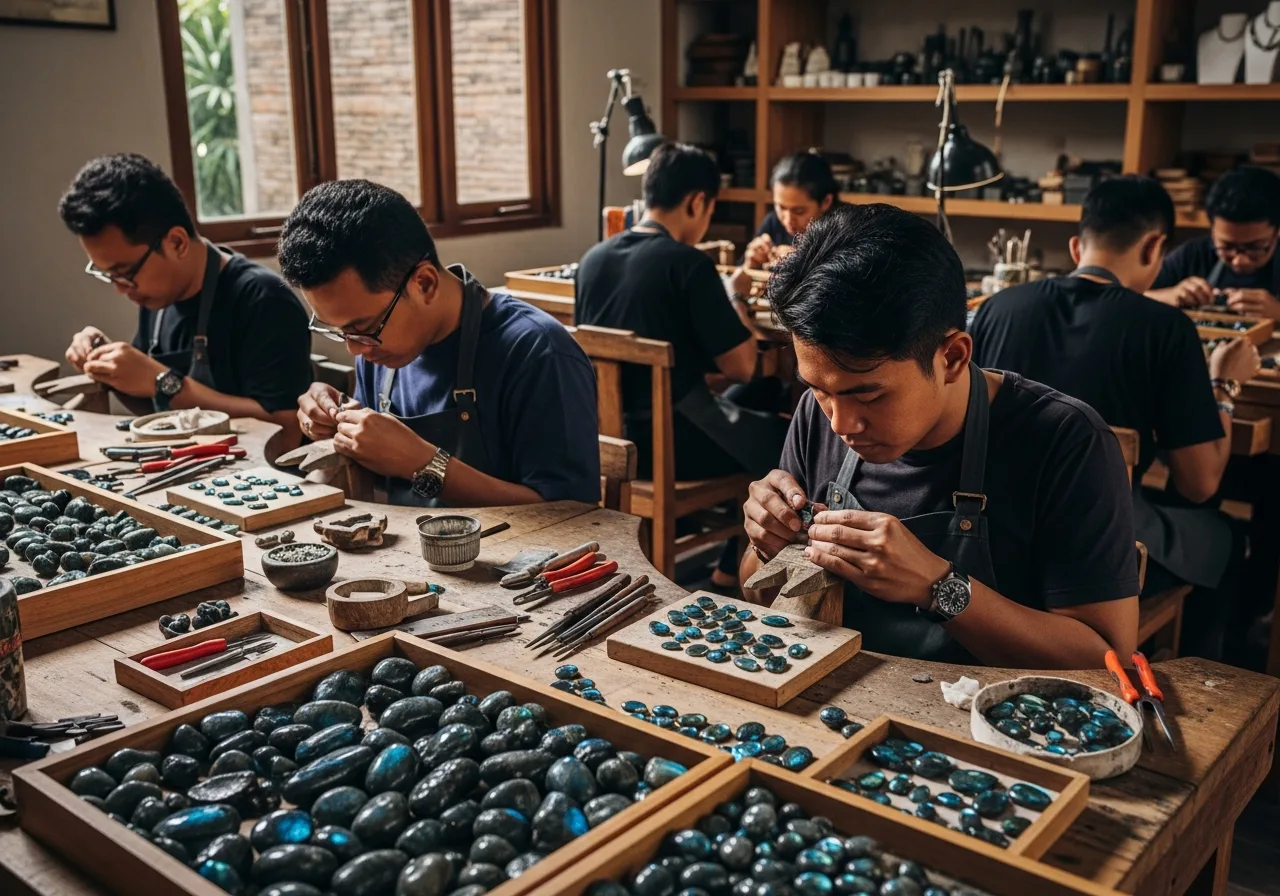
Bali Labradorite Wholesale specialises in B2B supply of labradorite furniture and handicrafts. This 2027 market briefing for importers, wholesalers, retailers, and interior contractors details color grades, supply chain, and market dynamics specific to “Bali labradorite” – i.e., labradorite gemstones and products sourced and/or manufactured in Indonesia/Bali for export and domestic wholesale.
Bali Labradorite Wholesale Color Grades: A 2027 Comparison for Retailers
Indonesia and Bali participate in a small but fast-growing niche within the global labradorite gemstone market. This is primarily driven by jewelry manufacturing, silver-craft exports, and metaphysical/wellness demand. This briefing provides a 2026–2027 wholesale market overview for “Bali labradorite,” encompassing gemstones and finished products sourced and/or manufactured in Indonesia/Bali for export and domestic wholesale.
1. Market Size & Growth (Global → Indonesia/Bali)
Global Labradorite Benchmark
The global labradorite market size is estimated around USD 0.7–1.8 billion in the mid-2020s, depending on the methodology used. One study projects USD 945.75 million in 2025, increasing to USD 1,562.40 million by 2033, representing a Compound Annual Growth Rate (CAGR) of approximately 6.1% from 2025 to 2032. Another estimate places the market at USD 1.8 billion in 2025, reaching USD 2.9 billion by 2034, with a CAGR of approximately 5.8%. A third study suggests USD 0.71 billion in 2026, expanding to USD 1.3–2.0 billion by 2033, indicating a CAGR of approximately 6.2–9.2%.
Jewelry is the dominant end-use segment, accounting for approximately 50–52% of labradorite demand. The global gemstone market overall is estimated at USD 36–37 billion in 2025–2026 and is expected to reach USD 58.04 billion by 2033, with a CAGR of approximately 6.7% from 2026 to 2033. Asia-Pacific drives approximately 42% of global gemstone demand.
Indonesia/Bali Labradorite Share (Inferred)
Industry reports do not specifically break out Indonesia/Bali for labradorite; they identify Canada, Madagascar, and Finland as major supply regions. Indonesia is primarily a manufacturing and jewelry-design hub, not a primary ore source. Therefore, its market share is inferred from jewelry exports and regional demand rather than mining output.
Based on Asia-Pacific’s leading role in gemstones (approximately 42% of global demand), Indonesia’s position as a mid-tier jewelry exporter in the region, and Bali’s specialisation in silver and gemstone jewelry for export (e.g., Bali Silver Export offers over 80 labradorite designs), a reasonable order-of-magnitude for Indonesia/Bali’s labradorite-linked wholesale activity is:
- Indonesia labradorite jewelry & loose-stone wholesale (2026): on the order of USD 20–40 million (approximately 1–3% of the global market).
- Bali’s share of Indonesia’s labradorite wholesale (2026): on the order of USD 10–20 million (approximately 50% of Indonesia’s total).
This niche is projected to grow faster than the global average, with a CAGR of approximately 8–12% (2026–2033), potentially reaching USD 35–80 million by 2033.
2. Supply Chain & Sourcing
Bali labradorite supply relies on imported raw materials. Key sources include Madagascar (the primary source for rough material processed in Bali), Canada (primarily for high-grade spectrolite), and Finland (also a source for spectrolite). These rough materials are then cut, polished, and incorporated into finished products in Bali.
Bali’s competitive advantage lies in its skilled artisans, established jewelry manufacturing infrastructure, and design capabilities, particularly for silver and gemstone combinations. This allows for value addition to imported rough stones.
3. Bali Labradorite Wholesale Color Grades: A 2027 Comparison
Labradorite is graded based on the intensity, coverage, and spectrum of its labradorescence (schiller effect). For wholesale purposes, these grades directly influence pricing and market positioning.
Grade A (High Grade)
- Characteristics: Exhibits strong, vibrant labradorescence across a significant portion of the stone’s surface (typically >70%). Colours include intense blues, greens, yellows, and occasionally oranges or purples. The flash is bright and clear, visible from multiple angles. Clarity is generally good, with minimal inclusions that detract from the optical effect.
- Wholesale Application: Primarily used for high-end jewelry, statement pieces, and premium decorative items where visual impact is paramount. These stones command the highest prices due to their rarity and aesthetic appeal.
Grade B (Medium Grade)
- Characteristics: Displays moderate to good labradorescence, covering 40–70% of the surface. The flash may be less intense or cover a narrower spectrum of colours compared to Grade A, often dominated by blues and greens. Some minor inclusions or less consistent flash may be present but do not significantly impair overall appearance.
- Wholesale Application: Suitable for a broad range of jewelry, including everyday wear, and medium-tier handicraft items. This grade offers a balance between visual quality and affordability, making it popular for volume sales.
Grade C (Commercial Grade)
- Characteristics: Shows limited or patchy labradorescence, covering <40% of the surface. The flash may be subtle, greyish, or present only in specific lighting conditions or angles. Inclusions are more common, and the base colour may be darker or less translucent.
- Wholesale Application: Used for entry-level jewelry, larger decorative objects where the flash is a secondary feature, or items where the stone is less prominent. This grade is the most economical option for bulk purchasing.
2027 Note: The demand for Grade A Bali labradorite is expected to remain robust in 2027, driven by international buyers seeking unique, high-quality pieces for boutique retail and interior design projects.
| Grade | Labradorescence Coverage | Colour Intensity | Clarity/Inclusions | Typical Use Cases | Price Point (Relative) |
|---|---|---|---|---|---|
| A (High) | >70% of surface | Strong, vibrant (blue, green, yellow, orange, purple) | Minimal, clear flash | High-end jewelry, statement pieces | Highest |
| B (Medium) | 40–70% of surface | Moderate (often blue, green) | Minor, consistent flash | Everyday jewelry, medium-tier handicrafts | Medium |
| C (Commercial) | <40% of surface | Limited, subtle, greyish | More common, patchy flash | Entry-level jewelry, large decorative items | Lowest |
4. Market Trends & Outlook for 2027
The Bali labradorite market is expected to see continued growth in 2027, particularly in the following areas:
- Sustainable Sourcing: Increased demand from international buyers for verifiable ethical sourcing practices for gemstones. While Bali is a manufacturing hub, attention to the origin of rough materials will be important.
- Customisation and Design: A growing trend towards bespoke jewelry and handicraft designs incorporating labradorite. Bali’s design capabilities offer a competitive advantage here.
- Metaphysical and Wellness Market: Sustained demand from the wellness sector for labradorite, valued for its perceived energetic properties. This drives sales of polished stones, carvings, and simple jewelry.
- E-commerce and Digital Platforms: Continued reliance on online B2B platforms for sourcing, requiring high-quality product photography and detailed grading descriptions.
5. Pricing Considerations for Importers & Wholesalers
Wholesale pricing for Bali labradorite is influenced by several factors:
- Grade: As detailed above, higher grades command significantly higher prices.
- Size and Weight: Larger stones (carats) or larger cut pieces generally have a higher per-carat or per-unit price, especially for higher grades.
- Cutting and Polishing Quality: Precision cutting and a high-quality polish enhance the stone’s appeal and value.
- Design Complexity (for finished products): Intricate jewelry designs or complex handicraft forms will incur higher manufacturing costs.
- Volume of Order: Larger wholesale orders often qualify for better unit pricing.
- Currency Fluctuations: Exchange rates between the Indonesian Rupiah and major trading currencies (USD, EUR, GBP) can impact landed costs.
Importers and wholesalers should anticipate price variations based on these factors and engage in clear communication regarding grading expectations and specifications.
6. Conclusion and Wholesale Opportunities
The Bali labradorite wholesale market offers significant opportunities for importers, wholesalers, retailers, and interior contractors seeking unique and high-quality gemstone products. Understanding the distinct color grades and market dynamics is crucial for strategic purchasing and inventory management. Bali’s expertise in design and manufacturing, combined with its access to global rough material, positions it as a key player in this specialised segment. We are equipped to provide detailed specifications and consistent supply across all grades to meet diverse client requirements.
For further information on Bali labradorite wholesale color grades or to discuss your specific requirements, request a wholesale quote on WhatsApp. We are ready to assist with your B2B needs.