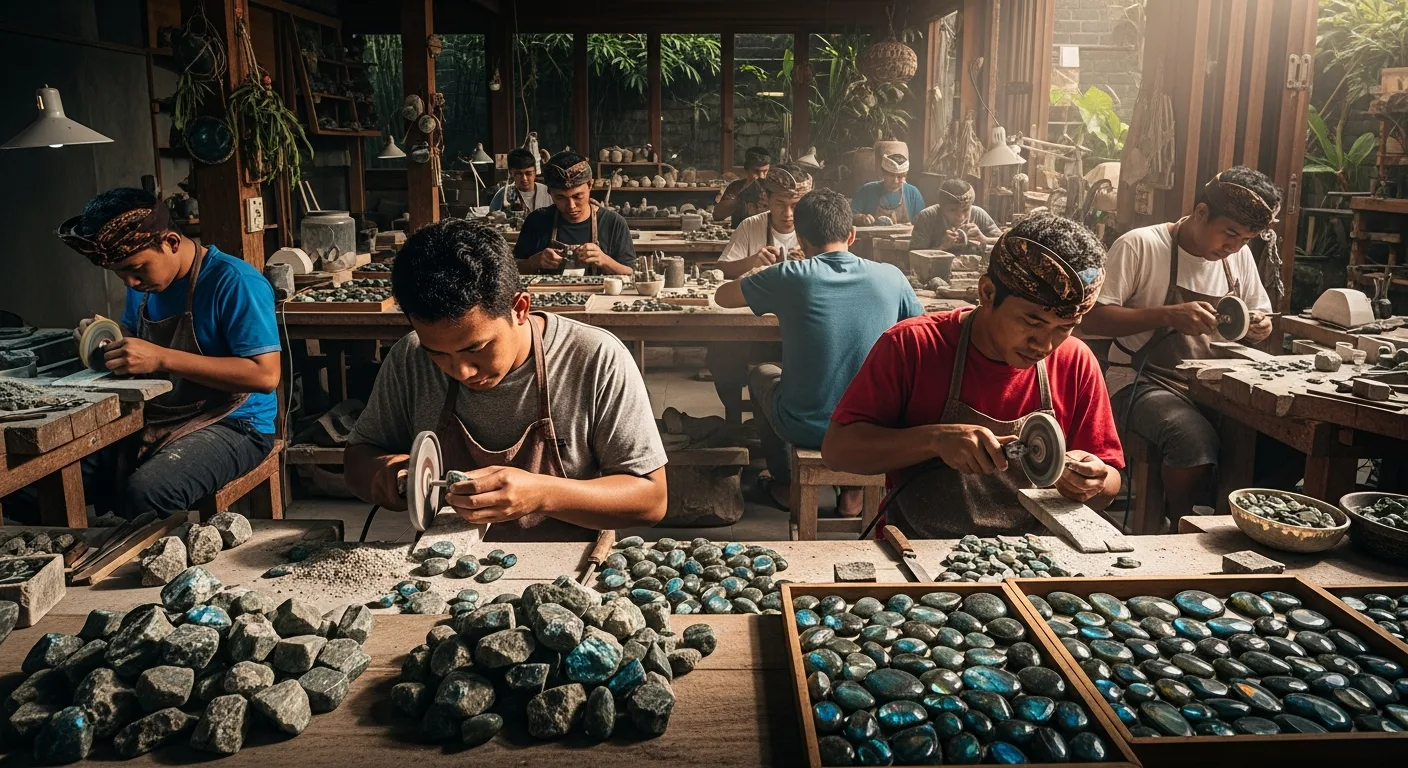
The global labradorite market is projected to reach USD 1.3–2.0 billion by 2033, with jewelry accounting for 50–52% of demand. Indonesia/Bali participates in a niche market, primarily as a manufacturing and export hub for labradorite jewelry and loose stones, estimated at USD 20–40 million in 2026.
Bali vs. Jaipur Labradorite Wholesale: A 2027 Cost and Quality Breakdown
This article provides a 2026–2027 wholesale market briefing for labradorite gemstones and jewelry sourced and/or manufactured in Indonesia/Bali for export and domestic wholesale. It addresses the cost and quality considerations relevant to importers, wholesalers, retailers, interior contractors, and trade buyers.
2027 Note on Market Dynamics
For 2027, sustained demand in the global gemstone market, particularly within Asia-Pacific, is expected to continue supporting the niche for labradorite. Supply chain efficiencies and manufacturing innovations in key hubs like Bali will be crucial for maintaining competitive pricing and quality in finished goods.
1. Market Size & Growth (Global → Indonesia/Bali)
Global Labradorite Benchmark
The global labradorite market size is estimated at approximately USD 0.7–1.8 billion in the mid-2020s, depending on the methodology employed for calculation. One study projects USD 945.75 million in 2025, increasing to USD 1,562.40 million by 2033, representing a Compound Annual Growth Rate (CAGR) of approximately 6.1% from 2025 to 2032. Another forecast suggests USD 1.8 billion in 2025, reaching USD 2.9 billion by 2034, with a CAGR of approximately 5.8%. A third estimate places the market at USD 0.71 billion in 2026, expanding to USD 1.3–2.0 billion by 2033, with a CAGR of approximately 6.2–9.2%.
Jewelry consistently represents the dominant end-use segment, accounting for approximately 50–52% of total labradorite demand. The broader global gemstone market is valued at approximately USD 36–37 billion in 2025–2026 and is expected to reach USD 58.04 billion by 2033, with a CAGR of approximately 6.7% from 2026 to 2033. Asia-Pacific is a significant driver, contributing approximately 42% of global gemstone demand.
Indonesia/Bali Labradorite Share (Inferred)
Industry reports typically do not specifically delineate Indonesia/Bali’s share of the global labradorite market, instead highlighting Canada, Madagascar, and Finland as primary supply regions for raw material. Indonesia functions primarily as a manufacturing and jewelry-design hub, rather than a significant source of raw labradorite ore. Therefore, its market share is inferred from jewelry exports and regional demand rather than direct mining output.
Based on Asia-Pacific’s leading role in gemstone consumption (approximately 42% of global demand), Indonesia’s position as a mid-tier jewelry exporter in the region, and Bali’s specialization in silver and gemstone jewelry for export (with examples such as Bali Silver Export offering over 80 labradorite designs), a reasonable order-of-magnitude for Indonesia/Bali’s labradorite-linked wholesale activity is estimated to be USD 20–40 million in 2026. This represents approximately 1–3% of the global labradorite market and 0.05–0.1% of the global gemstone market.
Growth in this segment is projected at approximately 10–15% annually, outpacing the global average for labradorite due to increasing demand for unique, handcrafted jewelry and home décor items. This would place Indonesia/Bali’s labradorite-linked wholesale activity in the range of USD 22–46 million for 2027.
2. Labradorite Sourcing & Supply Chain
Primary Ore Sources
The majority of raw labradorite material processed in Bali and Jaipur originates from Madagascar, Canada, and Finland. Madagascar is particularly noted for its high-quality blue and green flash labradorite, often referred to as ‘Madagascar Rainbow Labradorite.’ Canada (specifically Labrador) and Finland (spectrolite) are also significant sources, known for their distinct optical characteristics.
Bali’s Supply Chain Position
Bali’s role is predominantly that of a downstream processor and exporter of finished goods. Raw labradorite rough is imported, then cut, polished, and set into jewelry or incorporated into handicrafts and furniture. This manufacturing capability allows for significant value addition. Bali’s established infrastructure for artisanal craftsmanship, particularly in silverwork and wood carving, complements the processing of gemstones.
Jaipur’s Supply Chain Position
Jaipur, India, similarly acts as a major cutting, polishing, and manufacturing hub, particularly for gemstones. It benefits from a long history in gem cutting and a large, skilled labor force. Jaipur’s scale in gemstone processing is generally larger than Bali’s, handling a broader range of gemstones beyond labradorite. Its proximity to major shipping routes and established trade networks also contributes to its efficiency.
3. Quality & Grading: Bali vs. Jaipur
Labradorite Quality Factors
Labradorite quality is assessed by several factors, including:
- Labradorescence (Flash): The intensity, coverage, and color spectrum of the iridescent flash. High-quality stones exhibit a strong, full-spectrum flash across a significant portion of the stone.
- Clarity: The presence of inclusions, fractures, or cracks. Cleaner stones with fewer visible imperfections are valued higher.
- Cut: The shape and facet arrangement, which influences how effectively the labradorescence is displayed.
- Color: While the flash is paramount, the base color of the stone (e.g., dark grey, light grey, transparent) can also affect appeal.
Bali’s Quality Specialization
Bali specialises in artisanal quality. Due to the typically smaller-scale, handcrafted nature of production, there is often a greater emphasis on individual stone selection and skilled hand-cutting to maximise the unique flash of each piece. For jewelry, Bali often pairs labradorite with high-purity silver, leveraging its established silver-crafting heritage. For furniture and handicrafts, Bali focuses on integrating larger, statement labradorite pieces into bespoke designs, prioritising aesthetic impact and craftsmanship over mass production uniformity. This often results in higher perceived quality for unique, handcrafted items.
Jaipur’s Quality Specialization
Jaipur handles both mass-market and high-quality production. Its large-scale cutting facilities can produce consistent cuts and calibrations suitable for volume orders. While Jaipur also produces high-quality pieces, its broader market reach means it caters to a wider range of quality tiers, from commercial-grade to fine. Jaipur excels in precision cutting and calibration, which can be advantageous for large-scale jewelry manufacturing requiring uniformity. Quality control systems are often geared towards volume processing, ensuring consistency across large batches.
4. Cost & Pricing: Bali vs. Jaipur (2026–2027 Wholesale Estimates)
Pricing for labradorite wholesale is highly variable, influenced by quality, size, cut, volume, and prevailing market conditions. The figures below are approximate wholesale estimates for 2026–2027 and should be used as a guide only.
Loose Labradorite Cabochons (Wholesale, per carat)
| Quality Tier | Size Range | Bali (USD/carat) | Jaipur (USD/carat) | Notes |
|---|---|---|---|---|
| Commercial Grade (low flash, minor inclusions) | 10–20 carats | 0.30–0.60 | 0.25–0.50 | Suitable for costume jewelry, large volume orders. |
| Mid-Grade (moderate flash, some inclusions) | 5–15 carats | 0.70–1.20 | 0.60–1.00 | Good for everyday jewelry, smaller decorative items. |
| High-Grade (strong, full flash, clean) | 3–10 carats | 1.30–2.50 | 1.10–2.20 | Premium jewelry, collector pieces. |
| Premium/Designer Grade (exceptional flash, clarity) | 1–5 carats | 2.60–5.00+ | 2.30–4.50+ | High-end jewelry, bespoke designs. |
Finished Labradorite Jewelry (Wholesale, per piece)
Pricing for finished jewelry is more complex, factoring in metal weight, additional gemstones, design complexity, and brand. The following are indicative ranges for silver jewelry with labradorite:
- Small Pendants/Rings (commercial grade): Bali: USD 8–15; Jaipur: USD 7–13
- Medium Pendants/Rings (mid-grade): Bali: USD 18–35; Jaipur: USD 15–30
- Statement Pendants/Cuffs (high-grade): Bali: USD 40–80+; Jaipur: USD 35–70+
Labradorite Furniture & Décor (Wholesale, per piece)
For furniture and décor items incorporating labradorite, Bali often commands higher prices due to the emphasis on unique design, hand-craftsmanship, and integration with local materials like teak or suar wood. Jaipur’s offerings in this category are less prominent but may focus on more standardised, marble-based designs.
- Small Inlay Boxes: Bali: USD 25–60; Jaipur: USD 20–50
- Tabletops (small, with labradorite inlay): Bali: USD 150–400+; Jaipur: USD 120–350+
Factors Influencing Cost Differentials
The slight price differences between Bali and Jaipur can be attributed to several factors:
- Labor Costs: While both regions have competitive labor costs compared to Western markets, specific skill sets and local wage structures can create minor variances.
- Scale of Production: Jaipur’s larger-scale operations can sometimes achieve greater economies of scale for standard cuts and volume production. Bali’s strength lies in bespoke and artisanal production, which can incur higher per-unit costs but deliver unique value.
- Design & Craftsmanship: Bali’s reputation for intricate silverwork and wood carving adds value to its finished products, often resulting in higher pricing for unique designs and handcrafted appeal.
- Logistics: Proximity to major shipping ports and established trade routes can affect overall landed costs.
5. Logistics & Lead Times
Bali Logistics
Bali benefits from established air and sea freight routes for international export. Lead times for custom orders can range from 4–12 weeks, depending on design complexity and production volume. Standard stock items may have shorter lead times. Bali’s export ecosystem is well-versed in handling CITES regulations for certain wood products and other international shipping requirements.
Jaipur Logistics
Jaipur also has robust logistics infrastructure, with well-connected air cargo and sea freight options. Given its larger production capacity, lead times for high-volume, standardised gemstone orders can be competitive, often ranging from 3–10 weeks. For complex custom designs, lead times can be comparable to Bali.
6. Choosing Your Supplier: Bali or Jaipur
The choice between Bali and Jaipur for wholesale labradorite depends on specific buyer requirements:
- For Unique, Handcrafted, Artisanal Quality: Bali is the preferred choice. Buyers seeking distinctive designs, intricate silverwork, or custom furniture pieces with a strong artisanal narrative will find Bali’s offerings align well.
- For Volume, Consistency, and Price Competitiveness in Loose Stones: Jaipur often presents a strong option for buyers requiring large quantities of calibrated stones or consistent quality across high-volume orders, particularly for standard jewelry components.
- For High-End, Bespoke Jewelry: Both regions offer capabilities, but Bali’s specialisation in silver and gemstone combinations often provides a compelling proposition for unique, high-value pieces.
- For Furniture and Home Décor: Bali is the dominant player for integrating labradorite into furniture and decorative items, offering a distinct aesthetic and craftsmanship.
Ultimately, both Bali and Jaipur offer compelling value propositions in the global labradorite wholesale market. Understanding their respective strengths in quality, cost, and manufacturing specialisation is key to making an informed procurement decision for 2027 and beyond.
For further discussion or to request a wholesale quote, please request a wholesale quote on WhatsApp.